

The Lu-Ho polarizer consists of two identical prisms made of birefringent magnesium fluoride (MgF₂). The crystal axis is parallel to the propagation direction in one prism and perpendicular to it in the other. Consequently, e-light is refracted within the channel, while o-light passes through without deviation at all wavelengths.
For this reason, the Luo-Hung polarizer is particularly suitable for applications requiring rotation of the polarizer. The two output linearly polarized beams have fixed and mutually perpendicular vibration directions, and their polarization state remains unaffected by the prism's own rotation angle. Additionally, it offers advantages in high extinction ratio and beam collimation performance.
However, the Luo-Hung polarization prism has a low light damage resistance threshold and cannot be applied in high-power environments; moreover, it cannot be used in reverse, as this would induce conical light interference, leading to a reduction in the polarization extinction ratio.
As shown in Figure 1, the deflection angle of the Luo-Hung prism is determined by the crystal birefringence index ∆n and the prism apex angle θ, satisfying the following formula:
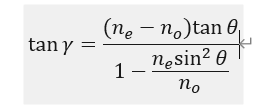
The deflection angle γ depends solely on the crystal material and prism structure, independent of the rotation angle. When white light is incident, colorless linearly polarized light is produced. Furthermore, to enhance the conversion efficiency of linearly polarized light, the prism angle θ is typically set to be greater than or equal to the Brust angle. This ensures that when light reaches the prism's inclined surface, the reflectivity of the original light (o light) is zero, allowing full transmission. Consequently, this minimizes reflection losses at the interface and improves the conversion rate of linearly polarized light.
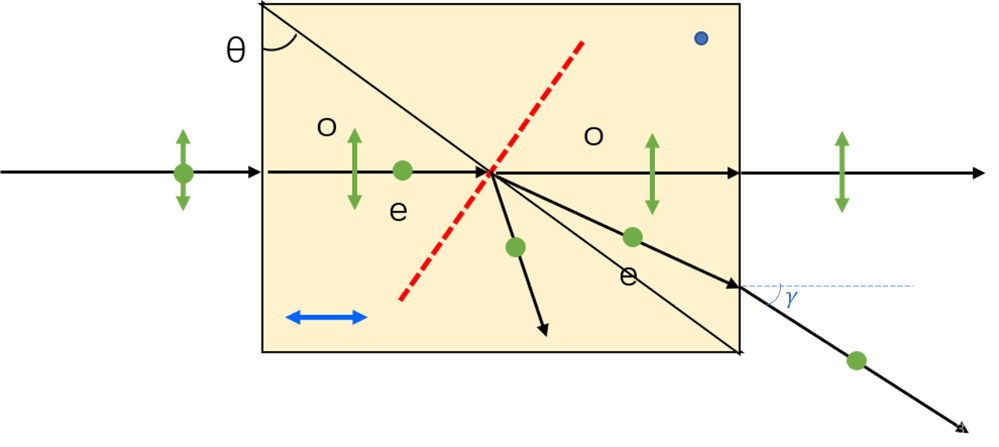
Figure 1 Structural diagram of the Luo-Hung prism
Rochon polarizer is made of two α-BBO prisms cemented together. The first prism, cut parallel to the optic axis, receives the light; the second, with the optic axis at right angles, transmits the ordinary ray without deviation but the extraordinary ray is deflected. A Rochon prism can be used to produce plane-polarized light and it can also be used with ultraviolet light. Any separation angle can be designed for specific wavelength upon request.