banner

Blog

Home

Blog

  • Rochon prism
    Rochon prism
    Aug 10, 2026
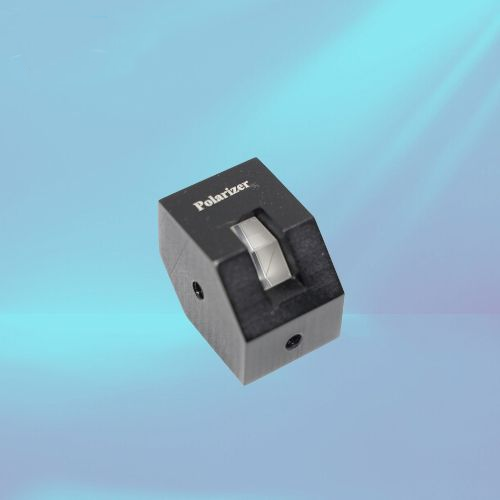
      The Lu-Ho polarizer consists of two identical prisms made of birefringent magnesium fluoride (MgF₂). The crystal axis is parallel to the propagation direction in one prism and perpendicular to it in the other. Consequently, e-light is refracted within the channel, while o-light passes through without deviation at all wavelengths.  For this reason, the Luo-Hung polarizer is particularly suitable for applications requiring rotation of the polarizer. The two output linearly polarized beams have fixed and mutually perpendicular vibration directions, and their polarization state remains unaffected by the prism's own rotation angle. Additionally, it offers advantages in high extinction ratio and beam collimation performance.  However, the Luo-Hung polarization prism has a low light damage resistance threshold and cannot be applied in high-power environments; moreover, it cannot be used in reverse, as this would induce conical light interference, leading to a reduction in the polarization extinction ratio.  As shown in Figure 1, the deflection angle of the Luo-Hung prism is determined by the crystal birefringence index ∆n and the prism apex angle θ, satisfying the following formula:   The deflection angle γ depends solely on the crystal material and prism structure, independent of the rotation angle. When white light is incident, colorless linearly polarized light is produced. Furthermore, to enhance the conversion efficiency of linearly polarized light, the prism angle θ is typically set to be greater than or equal to the Brust angle. This ensures that when light reaches the prism's inclined surface, the reflectivity of the original light (o light) is zero, allowing full transmission. Consequently, this minimizes reflection losses at the interface and improves the conversion rate of linearly polarized light. Figure 1 Structural diagram of the Luo-Hung prism Rochon polarizer is made of two α-BBO prisms cemented together. The first prism, cut parallel to the optic axis, receives the light; the second, with the optic axis at right angles, transmits the ordinary ray without deviation but the extraordinary ray is deflected. A Rochon prism can be used to produce plane-polarized light and it can also be used with ultraviolet light. Any separation angle can be designed for specific wavelength upon request.    
    Read More
  • DUAL BABYNINE-TYPE DEPOLARIZER
    DUAL BABYNINE-TYPE DEPOLARIZER
    Aug 04, 2026
    For a single H-V type depolarizer, it cannot depolarize all polarized light, particularly linearly polarized light in horizontal and vertical orientations, thus limiting its application scope. A single H-V depolarizer can be regarded as a Wollaston prism with an extremely small structural angle. As shown in Figure 1, light is split into light beams o and e in the front half, propagating orthogonally and in the same direction; in the rear half, it is further divided into two beams—oe and eo—which are linearly polarized with opposite refraction directions. The intensities of these two beams vary with the azimuth angle according to sine or cosine laws, typically differing from each other, resulting in significant polarization correlation. Therefore, when using an H-V depolarizer for monochromatic light depolarization, an azimuth angle of 45° is required.   Figure 1   Based on the principle of H-V type depolarizers, two H-V type depolarizers are combined through a 45-degree rotation to form a dual Babynett-type depolarizer, as shown in Figure 2. This design enables the second H-V type depolarizer to effectively depolarize the horizontal or vertical linear polarization components in the first H-V type depolarizer, thereby overcoming the functional limitations of a single H-V type depolarizer.   Figure 2: Structural diagram of the dual Babynine-type depolarizer  
    Read More
  • BIREFRINGENT CRYSTAL DEPOLARIZER
    BIREFRINGENT CRYSTAL DEPOLARIZER
    Jul 28, 2026
    Since nearly all detectors exhibit polarization sensitivity, a depolarizer must be placed before the detector to eliminate its dependence on the polarization of incident radiation and thereby improve accuracy. The principle of depolarization involves converting light that originally possesses only a specific polarization direction into a mixed state containing various random polarization directions, thereby eliminating polarization characteristics. Three methods exist for achieving depolarization: by altering the state of polarized light in terms of "time,"  "space," or "wavelength." A birefringent crystal depolarizer utilizes its "beam splitting property" to completely disrupt the orderly alignment of polarized light in space, achieving depolarization—that is, converting polarized light back into non-polarized light. Rather than "eliminating" polarization, it "neutralizes" it. The core principle is straightforward: it splits the originally unidirectional polarized light into countless beams with different orientations, which are then mixed together, resulting in light that appears to have no fixed direction. 1、 Multicolor light depolarizer The Lyot depolarizer is a typical polychromatic (white light) depolarizer, available in single-plate and double-plate configurations. The single-plate polychromatic depolarizer achieves optimal depolarization performance when the vibration plane of the incident polarized light forms a 45° angle with the optical axis. The double-plate depolarizer's effectiveness is independent of the incident light's polarization plane, making it more practical; its structure is shown in Figure 1. This depolarizer consists of two birefringent crystals with a thickness ratio of 2:1, whose optical axes are oriented at a 45° angle to each other. The entire assembly is fabricated by bonding or encapsulating two crystal plates with optical adhesive. Its operating principle involves incident light of different wavelengths experiencing distinct phase delays after passing through the birefringent elements, resulting in elliptically polarized light with varying ellipticity. The final output beam is a random combination of polarizations with different ellipticities, thereby achieving depolarization.     Figure 1 Lyot depolarizer   The Lyot depolarizer exhibits excellent compatibility, enabling it to work with various light sources and demonstrating significant practical value in applications such as gyroscopes and optical sensing. However, this depolarizer has certain limitations: it is only effective under conditions of a broad incident light spectrum and provides suboptimal depolarization performance for monochromatic light. The depolarization efficiency of the Lyot depolarizer depends on the operating wavelength, material, optical axis angle, and prism wedge angle.   2、 Monochromatic light depolarizer   Compared to multicolor light depolarizers, monochromatic light depolarizers have a broader range of applications in certain respects, as they generally perform well in depolarizing multicolor light as well. A single quarter-wave plate can serve as a pseudo-depolarizer. For quasi-planar polarized monochromatic light, when used solely for intensity measurement, its performance is quite satisfactory; it effectively mitigates errors caused by the polarization sensitivity of photodetectors, ensuring the reliability of test results. The most common type of monochromatic light depolarizer is the wedge-shaped depolarizer, as shown in Figure 2. Figure 2 A single optical wedge-type depolarizer When incident light passes through the depolarizer, it splits into O-light and E-light. Due to their different propagation speeds through the crystal, the two beams exhibit distinct phase differences at various exit positions. The phase varies correspondingly with changes in the crystal thickness. The emitted light undergoes periodic transitions between linearly polarized, elliptically polarized, and circularly polarized states, as illustrated in Figure 3. The key distinction between light exiting the depolarizer and natural light lies in their polarization states: the former maintains a consistent polarization state at every exit position, whereas the latter exhibits random polarization states across different positions. Figure 3: Trajectory of the emitted light polarization state as a function of position The drawbacks of this depolarizer are equally apparent. Firstly, the optical wedge angle must be sufficiently small; otherwise, it causes beam divergence and deflection. During operation, the distance between the depolarization device and the receiving device should not be excessive, as this compromises performance. Secondly, only when the incident light is perpendicular and its polarization plane forms a 45-degree angle with the depolarizer's optical axis can effective depolarization of linearly polarized light be achieved. These limitations highlight the shortcomings of depolarization devices in unit structures.  The structural differences between polychromatic and monochromatic depolarizers correspond to distinct variables in the phase delay calculation formula. The phase delay δ is calculated using the following formula: Here, λ represents the wavelength of the incident light, n₀ is the refractive index of light o, nₐ is the refractive index of light e, and d denotes the thickness of the birefringent crystal. The polychromatic light depolarizer features a parallel plate structure with constant thickness d; since the polychromatic light contains wavelengths from different spectral bands, their wavelengths (λ₁, λ₂,..., λₙ) vary, resulting in distinct phase differences. In contrast, the monochromatic light depolarizer designed for monochromatic incident light utilizes birefringent materials with varying thicknesses (d₁, d₂,..., dₙ), ensuring that the o-and e-polarized components at different positions on the exit surface exhibit distinct phase differences, thus enabling wedge-shaped fabrication.   3、 Circular Round-Off Detector When investigating circular birefringence or dichroism phenomena, it is often necessary to depolarize circularly polarized light. The most direct approach involves first converting the circularly polarized light into linearly polarized light using a quarter-wave plate, followed by depolarization of the monochromatic linearly polarized light.        
    Read More
  • NON-POLARIZING BEAMSPLITTER CUBE  APPLICATION
    NON-POLARIZING BEAMSPLITTER CUBE APPLICATION
    Jul 21, 2026
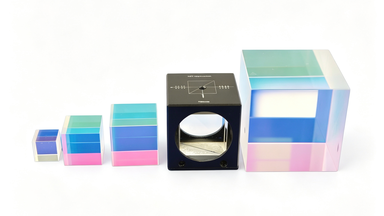
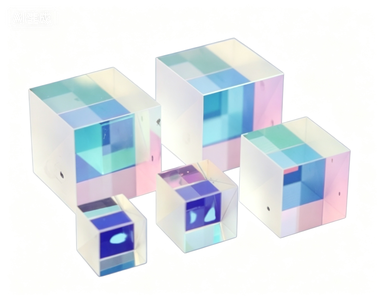
    our non-polarizing beamsplitter (NPBS) cube is composed of a pair of precision high-tolerance right-angle prismscemented together with a metallic-dielectric coating on the hypotenuse of one of the prisms. The low polarizationdependence of the metallic-dielectric coating allows the transmission and reflection of s and p-polarization states to bewithin 5% of each other. This means that the NPBS will not need to change the polarization of the incident beam. We can supply both broadband and single wavelength for the NPBS. In order to produce maximum transmission efficiency forthe appropriate wavelength range, an antireflective coating can be applied to each face of the beamsplitter. APPLICATIONS WSS Laser applications Fiber optical communication systems 40 G/100 G components                                                                          NON-POLARIZING BEAMSPLITTER CUBE   Dimensions Common specification Ready to Get Started? Inquiry by email: rose@mt-optics.com Related Products Polarizing cube beamsplitters   Optical Isolator     Thin Film Linear Polarizer About Us MT-Optics,Inc.was established in 2008, We are a private factory specializing of the export of multi-element optical compoment for imaging systems, and optomechanical equipment. MT-Optics owns advanced fabricating machine,including Optorun coating machine, CNC Grinding&polishing,High Speed &precision polishing,Ultrasonic cleaner,etc.And inspection instruments, like Zygo, Cary 5000, Trioptics Prism Master 0.5" prism measurement system and so on.Provider for high technology OEM customers.   Our Product Categories: Polarization Optics:Glan Taylor Polarizers,Glan Laser Polarizers,Wollaston Polarizers,Rochon Polarizers,High Transmission Glan Laser Polarizers,Glan Thompson Polarizers,Glan Thompson Polarizing Beamsplitter Cubes,Polarization Beam Displacer,Broad Band Polarization Beam Combiner,Low Order Waveplate,Cemented Zero Order Waveplate,Optically Contacted Zero Order Waveplate,Air Spaced Zero Order Waveplate,True Zero Order Waveplate,Dual Wavelength Waveplate,Achromatic Waveplate,Quartz Polarization Rotator,Polarization Cube Beamsplitter (PBS),Non Polarizing Beamsplitter Cube (NPBS),Thin Film Linear Polarizer,Optical Isolator.   VUV Customized Polarizers for Laser @193nm: 193nm Glan Taylor Polarizers, 193nm Glan Laser Polarizers, Rochon Polarizers 193nm, 193nm Low Order Waveplate,193nm Air Spaced Zero Order Waveplate,Vacuum Ultraviolet 193nm Series.   Traditional Optics: High Precision Wedge Prism, Micro Prism, Right Angle Prism, Anamorphic Prism Pairs, Dove Prism, Penta Prism, Roof Prism, Corner Cube Retroreflector, Rhomboid Prism, Fused Silica Plano Concave Lens, N-BK7 Plano Concave Lens, CaF2 Plano Convex Lens, Germanium Plano convex Lens, Double Convex Lens, Germanium Plano concave Lens, CaF2 Plano Concave Lens, Double Concave Lens, Meniscus Lens, Bandwidth Achromatic Lens, Square Cylindrical Lens, BK7 Optical Glass Windows, Plano Convex Lens, Fused Silica Windows, Borosilicate (Pyrex) Windows, Germanium (Ge) Windows, Sapphire Windows, Magnesium Fluoride (MgF2) Windows, Borofloat Windows, Brewster window, Dielectric High Reflection Mirrors, Dichroic Mirrors, Metal coated Mirrors (Al Ag Au), Beamsplitter Cube, Absorptive Neutral Density Filters, High-precision Colored Glass Filter, Calcium Fluoride (CaF2) Windows, Flat Plate Laser Beam Splitter.     Optical Coating: Dichroic Mirror Film, High Reflectivity Film, Metal Reflective Film, Polarizing Beam Splitter Film,Ordinary Beam Splitting Film.   IR Optics: Germanium (Ge) Windows, Sapphire Windows,Magnesium Fluoride (MgF2) Windows,Calcium Fluoride (CaF2) Windows,Zinc Sulfide (ZnS) Windows,Zinc Selenide (ZnSe) Windows     Crystal  Elements: Beta-Barium Borate (BBO) Crystal, Lithium Triborate (LBO) Crystal, Potassium Titanyl Phosphate (KTP) Crystal,Periodically Poled KTP (PPKTP) Crystal, Lithium Niobate (LiNbO3) Crystal,Periodically Poled LN (PPLN) Crystal, Potassium Dihydrogen Dideuterium Phosphate (KDP-KD*P) Crystal, Calcite (CaCO₃) Crystal, Yttrium Orthovanadate (YVO4) Crystal, Alpha-Barium Borate (α-BBO) Crystal, Neodymium Doped Gadolinium Orthovanadate (Nd:GdVO4) Crystal, Er:Yb:YAl₃(BO₃)₄ Crystal, Potassium Gadolinium Tungstate (KGW) Crystal, Neodymium Doped Yttrium Orthovanadate (Nd:YVO4) Crystal, Terbium Gallium Garnet (TGG) Crystal, Chromium Doped Yttrium Aluminum Garnet (Cr4+:YAG) Crystal   Ready to Get Started? Inquiry by email: rose@mt-optics.com  
    Read More
  • POLARIZING BEAMSPLITTER CUBE APPLICATIONS
    POLARIZING BEAMSPLITTER CUBE APPLICATIONS
    Jul 14, 2026
    Our polarizing beamsplitter (PBS) cube is composed of a pair of precision high-tolerance right-angle prisms cemented together. One of the prisms has a partially reflective metallic-dielectric coating applied to its hypotenuse. The incident light should enter the prism with the coated hypotenuse in order to minimize power passing through the optical cement. The PBS can split the unpolarized beam into two orthogonal, linearly polarized components. P-polarized light is transmitted, whiles-polarized light is reflected, both with negligible absorption. The extinction ratio is better than 1000:1 for beamsplitters made with N-BK7 glass, and better than 100.1 for beamsplitters made with UV fused sllica. These cubes are recommended for use in pulsed laser systems and for purifying polarization in multimode high-power lasers. APPLICATIONS WSS Laser applications Fiber optical communication systems 40 G/100 G components POLARIZING BEAMSPLITTER CUBE   Dimensions   Common Specification Material N-BK7 or UV fused silica Typical Dimension 3 mm x3 mm x3 mm, 3.2 mm x3.2 mmx 3.2 mm Flatness λ/4@632.8nm Surface Quality (scratch/dig) Better than 40-20 Beam Deviation <3 arc minute Incidence Angle 0+/-3 Principal Transmittance Tp>95%, Ts< 1% Principal Reflectance Rs> 99%, Rp< 5% Coating "Polarizing beamsplitter coating on hypotenuse;AR coating on other input and output faces"   Other sizes, wedged angles, diameters, and coatings are also available upon request Ready to Get Started? Inquiry by email: rose@mt-optics.com Related Products  Non Polarizing Beamsplitter Cube (NPBS) Optical Isolator Thin Film Linear Polarizer About Us MT-Optics,Inc.was established in 2008, We are a private factory specializing of the export of multi-element optical compoment for imaging systems, and optomechanical equipment. MT-Optics owns advanced fabricating machine,including Optorun coating machine, CNC Grinding&polishing,High Speed &precision polishing,Ultrasonic cleaner,etc.And inspection instruments, like Zygo, Cary 5000, Trioptics Prism Master 0.5" prism measurement system and so on.Provider for high technology OEM customers.   Our Product Categories: Polarization Optics:Glan Taylor Polarizers,Glan Laser Polarizers,Wollaston Polarizers,Rochon Polarizers,High Transmission Glan Laser Polarizers,Glan Thompson Polarizers,Glan Thompson Polarizing Beamsplitter Cubes,Polarization Beam Displacer,Broad Band Polarization Beam Combiner,Low Order Waveplate,Cemented Zero Order Waveplate,Optically Contacted Zero Order Waveplate,Air Spaced Zero Order Waveplate,True Zero Order Waveplate,Dual Wavelength Waveplate,Achromatic Waveplate,Quartz Polarization Rotator,Polarization Cube Beamsplitter (PBS),Non Polarizing Beamsplitter Cube (NPBS),Thin Film Linear Polarizer,Optical Isolator.     VUV Customized Polarizers for Laser @193nm: 193nm Glan Taylor Polarizers, 193nm Glan Laser Polarizers, Rochon Polarizers 193nm, 193nm Low Order Waveplate,193nm Air Spaced Zero Order Waveplate,Vacuum Ultraviolet 193nm Series.     Traditional Optics: High Precision Wedge Prism, Micro Prism, Right Angle Prism, Anamorphic Prism Pairs, Dove Prism, Penta Prism, Roof Prism, Corner Cube Retroreflector, Rhomboid Prism, Fused Silica Plano Concave Lens, N-BK7 Plano Concave Lens, CaF2 Plano Convex Lens, Germanium Plano convex Lens, Double Convex Lens, Germanium Plano concave Lens, CaF2 Plano Concave Lens, Double Concave Lens, Meniscus Lens, Bandwidth Achromatic Lens, Square Cylindrical Lens, BK7 Optical Glass Windows, Plano Convex Lens, Fused Silica Windows, Borosilicate (Pyrex) Windows, Germanium (Ge) Windows, Sapphire Windows, Magnesium Fluoride (MgF2) Windows, Borofloat Windows, Brewster window, Dielectric High Reflection Mirrors, Dichroic Mirrors, Metal coated Mirrors (Al Ag Au), Beamsplitter Cube, Absorptive Neutral Density Filters, High-precision Colored Glass Filter, Calcium Fluoride (CaF2) Windows, Flat Plate Laser Beam Splitter.     Optical Coating: Dichroic Mirror Film, High Reflectivity Film, Metal Reflective Film, Polarizing Beam Splitter Film,Ordinary Beam Splitting Film     IR Optics: Germanium (Ge) Windows, Sapphire Windows,Magnesium Fluoride (MgF2) Windows,Calcium Fluoride (CaF2) Windows,Zinc Sulfide (ZnS) Windows,Zinc Selenide (ZnSe) Windows     Crystal  Elements: Beta-Barium Borate (BBO) Crystal, Lithium Triborate (LBO) Crystal, Potassium Titanyl Phosphate (KTP) Crystal,Periodically Poled KTP (PPKTP) Crystal, Lithium Niobate (LiNbO3) Crystal,Periodically Poled LN (PPLN) Crystal, Potassium Dihydrogen Dideuterium Phosphate (KDP-KD*P) Crystal, Calcite (CaCO₃) Crystal, Yttrium Orthovanadate (YVO4) Crystal, Alpha-Barium Borate (α-BBO) Crystal, Neodymium Doped Gadolinium Orthovanadate (Nd:GdVO4) Crystal, Er:Yb:YAl₃(BO₃)₄ Crystal, Potassium Gadolinium Tungstate (KGW) Crystal, Neodymium Doped Yttrium Orthovanadate (Nd:YVO4) Crystal, Terbium Gallium Garnet (TGG) Crystal, Chromium Doped Yttrium Aluminum Garnet (Cr4+:YAG) Crystal   Ready to Get Started? Inquiry by email: rose@mt-optics.com          
    Read More
  • How to choose the Glan prism series?
    How to choose the Glan prism series?
    May 14, 2024
    A Polarizer is an important optical component that is widely used in laser systems to generate the linear polarization laser. MT-Optics, Inc makes following polarizers with four materials, a-BBO, Calcite, YVO4 and Quartz, suitable for the widest spectrum and high polarization purity application. Following is the summary for kinds of polarizers and you can compare them to choose the best suitable for your application.   Polarizer Material Illustration Properties and Application Glan-Taylor Polarizer a-BBO (200–3500nm) Calcite (230–2300nm) YVO4 (500–4000nm) Air-SpacedClose to Brewster’s Angle CuttingHigh Polarization PurityShort LengthSuitable for Low to Medium Power Application Glan-Laser Polarizer a-BBO (200–3500nm) Calcite (230–2300nm) YVO4 (500–4000nm) Air-SpacedClose to Brewster’s Angle CuttingHigh Damage ThresholdMounted with escape windowSuitable for High Power Application High Transmission Glan Laser Polarizer YVO4 (450–4000nm) Calcite (550–2400nm) Air-SpacedAll Brewster’s Angle CuttingHighest TransmissionMounted with escape windowSuitable for High Power ApplicationBrewster Angle Input  Glan-Thompson Polarizer a-BBO (220–900nm) Calcite (350–2300nm) CementedWide Acceptance Angle FieldSuitable for Low Power Application Glan Thompson Polarizing Beamsplitter Cubes Calcite (350–2300nm) CementedHigh Polarization PurityHigh TransmissionSuitable for Low Power ApplicationSplit o-ray & e-ray at 45° Broad band Polarization Beam Combiner YVO4 (500–4000nm) Air SpacedHigh Damage ThresholdBroad Band for 500–4000nm range Wollaston Polarizer a-BBO (200–3500nm) Calcite (550–2300nm) YVO4 (500–4000nm) Quartz (200–2300nm) CementedSeparates ordinary and extraordinary beams at a certain angleSuitable for low power applications and scenarios requiring large beam deviation Rochon Polarizer a-BBO (200–3500nm) YVO4 (500–4000nm) Quartz (200–2300nm) Optically ContactedHigh Polarization PuritySuitable for Low or High Power Applications   Material Comparison Table Text Extraction:   YVO4 Calcite a-BBO Quartz Transparency 500–4000nm 350–2200nm 200–3500nm 200–2300nm Crystal Class (Uniaxial) Positive (no=na=nb, ne=nc) Negative (no=na=nb, ne=nc) Negative (no=na=nb, ne=nc) Positive (no=na=nb, ne=nc) Mohs Hardness 5 3 4.5 7 Thermal Expansion Coefficient aa=4.43×10⁻⁶/k ac=11.37×10⁻⁶/k aa=24.39×10⁻⁶/k ac=5.68×10⁻⁶/k aa=4×10⁻⁶/k ac=36×10-6/k aa=6.2×10⁻⁶/k ac=10.7×10⁻⁶/k Hygroscopic Susceptibility Low Low Low Low
    Read More

  • How to Scientifically Select Waveplate Types?
    How to Scientifically Select Waveplate Types?
    Jan 20, 2025
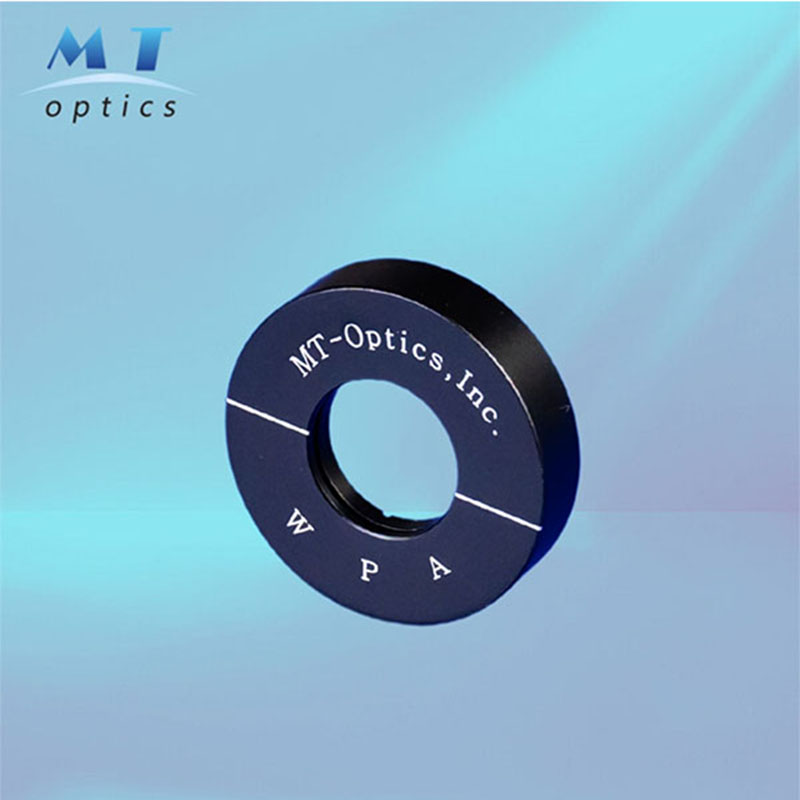
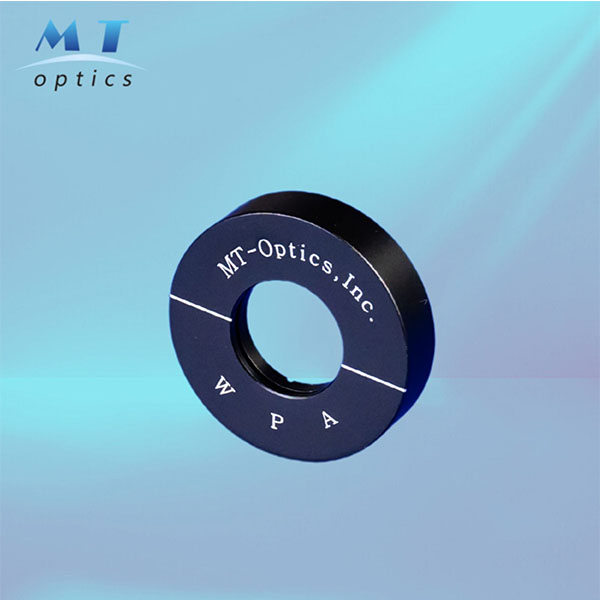
        Wave plates are mainly divided into four types:   Low-order waveplate(WPL) Zero-order waveplate-Cemented by Epoxy(WPC) Zero-order waveplate-Optically Contacted(WPO) Zero-order waveplate-Air Spaced(WPA) True zero-order waveplate-Cemente(WPF) True zero-order waveplate-Single Plate(WPS) Achromatic waveplate(AWP) Quarz Polarzation Rotator(WPR)  
    Read More

Subscribe To Our Newslettter

We has been adhering to the principle of continuous innovation, continuously improving production processes and technologies, and actively developing new products

leave a message

leave a message
If you are interested in our products and want to know more details,please leave a message here,we will reply you as soon as we can.
submit

home

products

WhatsApp

contact