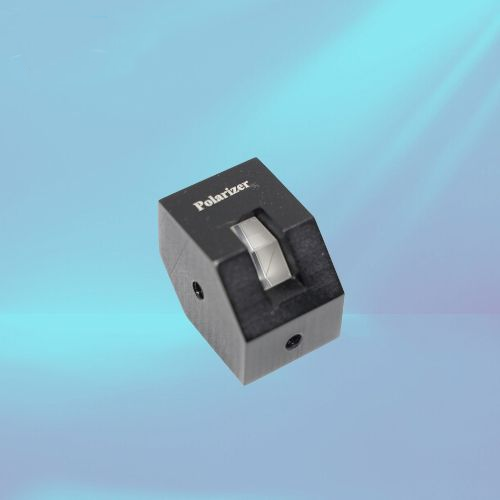
BIREFRINGENT CRYSTAL DEPOLARIZER
Jul 28, 2026
Since nearly all detectors exhibit polarization sensitivity, a depolarizer must be placed before the detector to eliminate its dependence on the polarization of incident radiation and thereby improve accuracy. The principle of depolarization involves converting light that originally possesses only a specific polarization direction into a mixed state containing various random polarization directions, thereby eliminating polarization characteristics. Three methods exist for achieving depolarization: by altering the state of polarized light in terms of "time," "space," or "wavelength."
A birefringent crystal depolarizer utilizes its "beam splitting property" to completely disrupt the orderly alignment of polarized light in space, achieving depolarization—that is, converting polarized light back into non-polarized light. Rather than "eliminating" polarization, it "neutralizes" it. The core principle is straightforward: it splits the originally unidirectional polarized light into countless beams with different orientations, which are then mixed together, resulting in light that appears to have no fixed direction.
1、 Multicolor light depolarizer
The Lyot depolarizer is a typical polychromatic (white light) depolarizer, available in single-plate and double-plate configurations. The single-plate polychromatic depolarizer achieves optimal depolarization performance when the vibration plane of the incident polarized light forms a 45° angle with the optical axis. The double-plate depolarizer's effectiveness is independent of the incident light's polarization plane, making it more practical; its structure is shown in Figure 1. This depolarizer consists of two birefringent crystals with a thickness ratio of 2:1, whose optical axes are oriented at a 45° angle to each other. The entire assembly is fabricated by bonding or encapsulating two crystal plates with optical adhesive. Its operating principle involves incident light of different wavelengths experiencing distinct phase delays after passing through the birefringent elements, resulting in elliptically polarized light with varying ellipticity. The final output beam is a random combination of polarizations with different ellipticities, thereby achieving depolarization.
Figure 1 Lyot depolarizer
The Lyot depolarizer exhibits excellent compatibility, enabling it to work with various light sources and demonstrating significant practical value in applications such as gyroscopes and optical sensing. However, this depolarizer has certain limitations: it is only effective under conditions of a broad incident light spectrum and provides suboptimal depolarization performance for monochromatic light. The depolarization efficiency of the Lyot depolarizer depends on the operating wavelength, material, optical axis angle, and prism wedge angle.
2、 Monochromatic light depolarizer
Compared to multicolor light depolarizers, monochromatic light depolarizers have a broader range of applications in certain respects, as they generally perform well in depolarizing multicolor light as well. A single quarter-wave plate can serve as a pseudo-depolarizer. For quasi-planar polarized monochromatic light, when used solely for intensity measurement, its performance is quite satisfactory; it effectively mitigates errors caused by the polarization sensitivity of photodetectors, ensuring the reliability of test results. The most common type of monochromatic light depolarizer is the wedge-shaped depolarizer, as shown in Figure 2.
Figure 2 A single optical wedge-type depolarizer
When incident light passes through the depolarizer, it splits into O-light and E-light. Due to their different propagation speeds through the crystal, the two beams exhibit distinct phase differences at various exit positions. The phase varies correspondingly with changes in the crystal thickness. The emitted light undergoes periodic transitions between linearly polarized, elliptically polarized, and circularly polarized states, as illustrated in Figure 3. The key distinction between light exiting the depolarizer and natural light lies in their polarization states: the former maintains a consistent polarization state at every exit position, whereas the latter exhibits random polarization states across different positions.
Figure 3: Trajectory of the emitted light polarization state as a function of position
The drawbacks of this depolarizer are equally apparent. Firstly, the optical wedge angle must be sufficiently small; otherwise, it causes beam divergence and deflection. During operation, the distance between the depolarization device and the receiving device should not be excessive, as this compromises performance. Secondly, only when the incident light is perpendicular and its polarization plane forms a 45-degree angle with the depolarizer's optical axis can effective depolarization of linearly polarized light be achieved. These limitations highlight the shortcomings of depolarization devices in unit structures.
The structural differences between polychromatic and monochromatic depolarizers correspond to distinct variables in the phase delay calculation formula. The phase delay δ is calculated using the following formula:
Here, λ represents the wavelength of the incident light, n₀ is the refractive index of light o, nₐ is the refractive index of light e, and d denotes the thickness of the birefringent crystal. The polychromatic light depolarizer features a parallel plate structure with constant thickness d; since the polychromatic light contains wavelengths from different spectral bands, their wavelengths (λ₁, λ₂,..., λₙ) vary, resulting in distinct phase differences. In contrast, the monochromatic light depolarizer designed for monochromatic incident light utilizes birefringent materials with varying thicknesses (d₁, d₂,..., dₙ), ensuring that the o-and e-polarized components at different positions on the exit surface exhibit distinct phase differences, thus enabling wedge-shaped fabrication.
3、 Circular Round-Off Detector
When investigating circular birefringence or dichroism phenomena, it is often necessary to depolarize circularly polarized light. The most direct approach involves first converting the circularly polarized light into linearly polarized light using a quarter-wave plate, followed by depolarization of the monochromatic linearly polarized light.
Read More